Quantum Mobility is built around a coordinated back-office architecture that supports transaction processing, reconciliation, clearing, settlement, financial control, image processing, and enforcement across multi-operator environments.
System Architecture
A single coordinated back-office architecture — production-grade, deterministic, auditable. Designed for operators, agencies, and DOTs. Tolling is the primary deployment model today. The same system supports evolution toward RUC.
Transaction Processing
Tag-based and video tolling, trip building, rating, account linkage.
Reconciliation & Clearing
Multi-source matching, exception detection, case management, cross-operator clearing.
Transaction-to-settlement traceability, financial and operational reporting.
Eight coordinated steps. One back-office system. End-to-end traceability.
The Shared Coordination Backbone
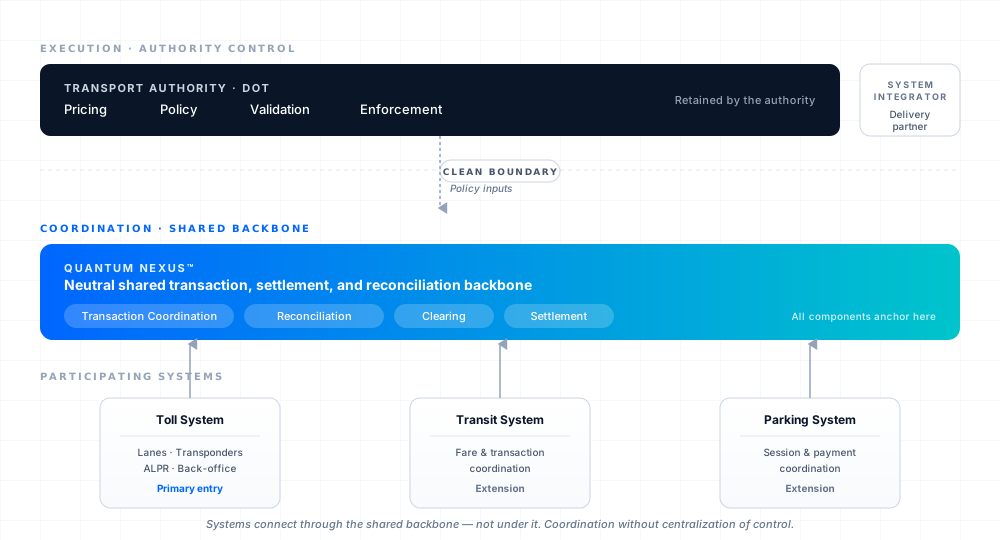
The system includes a shared coordination backbone that enables transaction coordination, reconciliation, clearing, and settlement across operators. This capability differentiates the system by enabling consistent coordination across multiple operators and jurisdictions. Where required, this shared backbone may be referred to as Quantum Nexus™.
Transaction Coordination
Transactions across participating systems.
Reconciliation & Clearing
Across operators and agencies.
Settlement & Financial Distribution
Consistent financial closure.
Cross-System Workflow Consistency
Coordinated workflows across systems.
Authority retains execution. The shared backbone handles coordination. Systems connect through it — not under it.
Coordination is built into the system architecture — not introduced as a separate control mechanism.
Governance-First Architecture
Mobility systems operate in regulated environments where control must remain with authorities. The architecture separates execution (authority-controlled) from coordination (system-managed) with a clean boundary between them.
Execution — Authority Systems
Pricing
Policy
Validation
Enforcement
Coordination — The System
Transaction coordination
Reconciliation
Clearing
Settlement
Interoperability without centralization of control.
Governance-first architecture is a primary differentiator of Quantum Mobility alongside the shared coordination backbone.
Image Processing & Enforcement
Image processing (Quantum Vision™) and enforcement are core system capabilities — not optional add-ons. Image processing feeds transaction creation; unpaid transactions feed violation management; all within a single coordinated system.
Quantum Vision™ — Image Processing
AI-based license plate recognition with continuous accuracy improvement
Vehicle identification and matching
Multi-image correlation and confidence scoring
AI-assisted recognition and validation
Manual review workflows for low-confidence reads
High-volume image processing across distributed environments
Enforcement & Violation Management
Violation creation from unpaid transactions
Notice generation and customer communication
Violation aging and escalation
Dispute handling, affidavits, and adjudication
Payment processing and adjustments
Collections and escalation workflows
Image processing, transaction creation, violation management, and settlement — handled within a single coordinated system.
Quantum Vision™ is the name for image processing only. Enforcement is a capability within the back-office system — not a separate product.
AI-Enabled Intelligence
AI is a supporting layer on top of the core system architecture. The system remains deterministic, auditable, and explainable — AI enhances visibility and decision support, it does not replace deterministic workflows.
Exception & Anomaly Detection
Exception detection and prioritization; reconciliation anomaly identification.
Forecasting
Forecasting and operational trend analysis.
Decision Support
Decision support for performance and policy simulation.
Mobility Intelligence
Transaction and mobility intelligence through reporting layers such as Quantum Atlas™.
AI strengthens operational visibility, forecasting, and exception management. It does not replace deterministic reconciliation, settlement, or governance workflows.
Deployment Models
Deployable through operator-led, agency-led, SI-led, or partner-led programs — while keeping operators and authorities at the center of control.
Operator / Agency-Led Modernization
Modernize reconciliation, settlement, and financial visibility within existing toll environments.
SI-Led Modernization
Deploy within broader program architectures while reducing custom coordination and settlement complexity.
Toll → RUC Evolution
Extend the same system foundation toward evolving charging models without rebuilding core infrastructure.
Expansion Beyond Tolling
Add adjacent domains such as transit, parking, EV charging, or fleets through the same backbone where required.
Full-Stack Deployment (Emerging Markets)
Deploy a unified multi-domain mobility system from day one, using the same coordinated transaction, reconciliation, and settlement architecture.
Deploy through the model that fits the program — while keeping operators and authorities at the center of control.
Designed for Regulated Tolling and Mobility Systems
Quantum Mobility is designed for environments where financial accuracy, auditability, operational control, and interoperability are critical.
Multi-Agency Coordination
Multi-agency coordination with independent authority control.
Deterministic Financial Workflows
Deterministic financial workflows and audit trails.
Transparent Clearing & Settlement
Transparent clearing and settlement across operators.
Scalable Infrastructure
Scalable infrastructure for modernization and expansion.
System behavior must be predictable, traceable, and institutionally safe.
A System That Coordinates — Without Compromising Control
Quantum Mobility provides a tolling and RUC back-office system, differentiated by a shared coordination backbone that enables coordinated reconciliation, settlement, interoperability, image processing, and enforcement across operators — without compromising authority control, financial accountability, or delivery realism.