Quantum Mobility delivers a deployable tolling and RUC back-office system for operators, agencies, and DOTs modernizing reconciliation, settlement, interoperability, and auditability across multi-operator environments.
Deployable through operator-led, agency-led, SI-led, or partner-led programs.
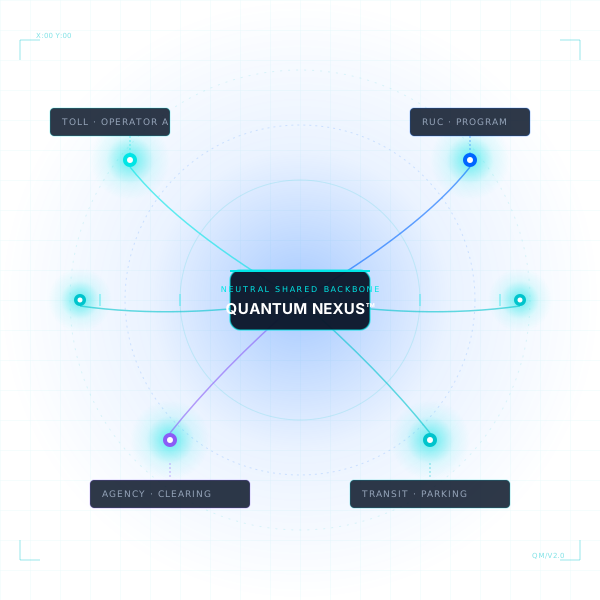
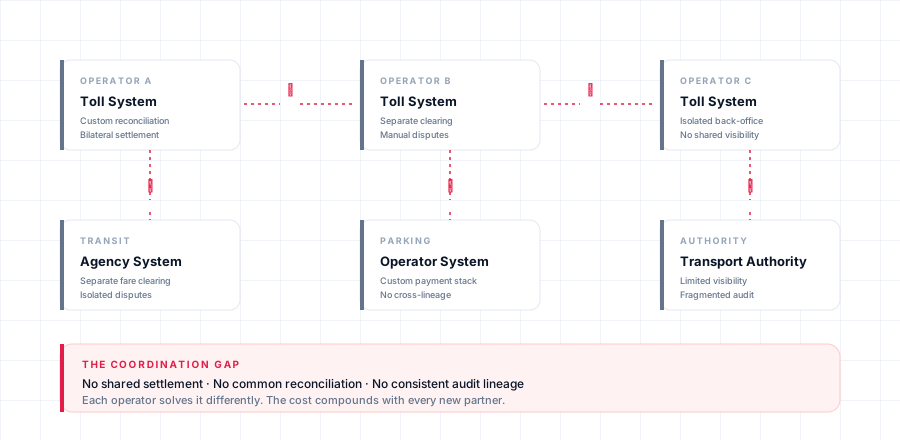
Toll systems operate independently across agencies, vendors, and jurisdictions. This creates:
Across operators working to different rule sets and data models.
Inconsistent financial closure across jurisdictions and operators.
Dispute handling overhead that scales with every new integration.
No shared view into financial outcomes across operators and agencies.
Most systems were built to process transactions within one boundary — not coordinate across many.
Quantum Mobility delivers a deployable tolling and RUC back-office system for operators, agencies, and DOTs. The system is designed to improve:
Across operators.
Consistent financial closure.
Across agencies and jurisdictions.
Across multi-operator environments.
The system includes:
Enforcement and image processing are fully integrated into the back-office system, while also being deployable independently where required. The same system foundation supports RUC evolution without rebuilding core infrastructure.
A single coordinated back-office system — modular internally, unified in deployment.
AI-enabled analytics and operational intelligence can be layered on top of the same system to improve visibility, exception management, and decision support. Explore system components →
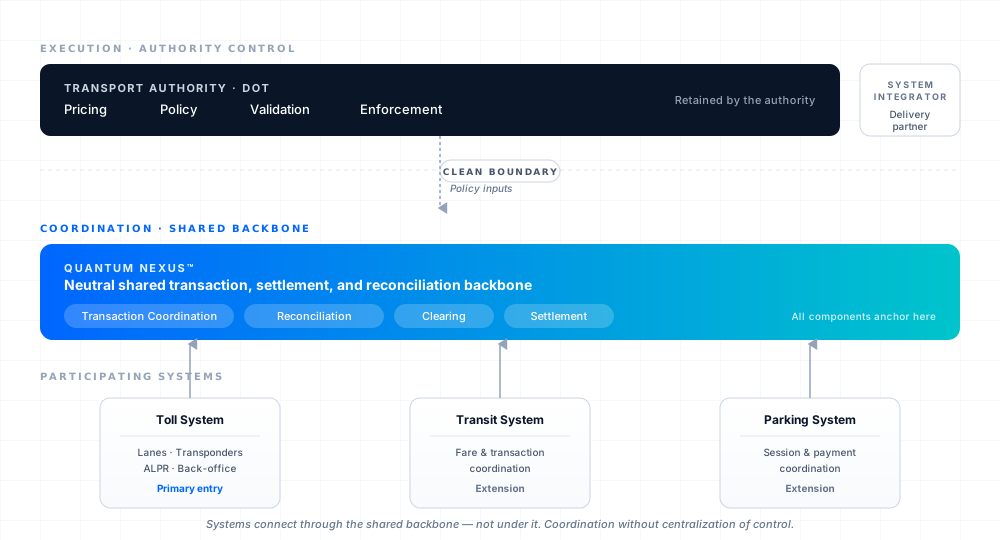
Quantum Mobility is designed on a governance-first architecture for regulated, multi-authority environments. Traditional platforms often require centralization of control, settlement visibility, or operational dependency. The architecture supports interoperability while preserving authority ownership, policy control, revenue responsibility, and system independence.
Interoperability without centralization of control.
Governance is embedded into how the system is designed — not layered on top. Where AI is used, it is positioned as decision support, analytics, forecasting, and exception intelligence — not as a replacement for authority control, pricing decisions, or policy ownership.
The Quantum Mobility back-office system includes a shared coordination capability that enables:
Across operators.
Across agencies.
Consistent financial closure.
Coordinated workflows across systems.
This capability differentiates the system by enabling consistent coordination across multiple operators and jurisdictions.
Where required, this shared backbone may be referred to as Quantum Nexus™.
Coordination is built into the system architecture — not introduced as a separate control mechanism.
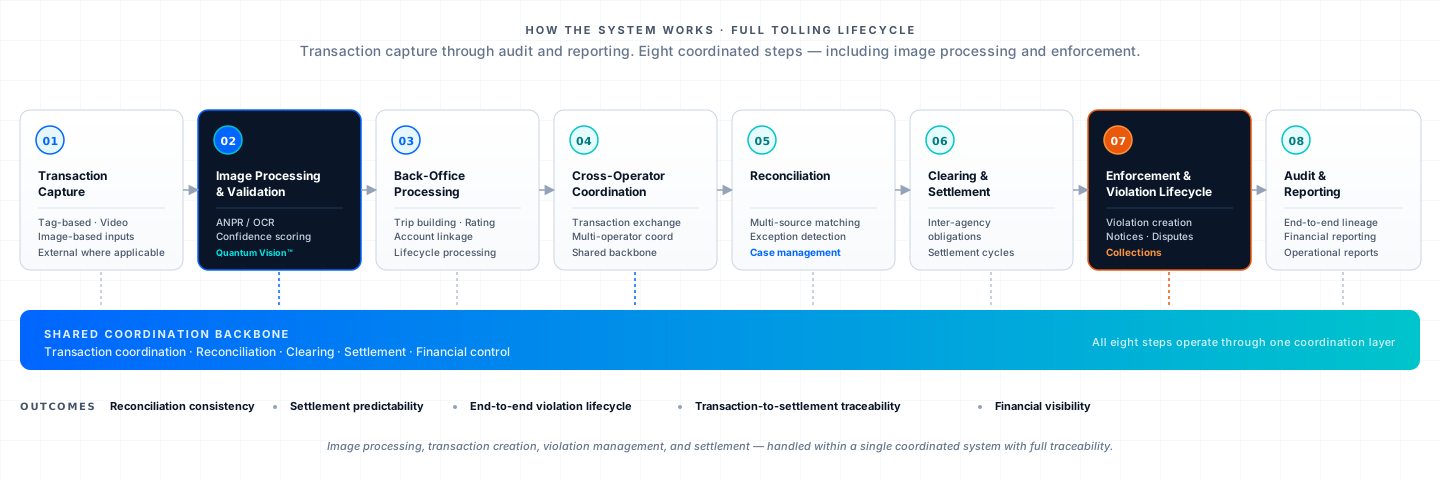
AI-based image processing and computer vision — the image layer of the back-office system.
Deep-learning license plate recognition runs continuously on production video streams, returning plate reads with confidence scores for every capture event.
Correlate plates across multiple capture events within a trip, and match recognized vehicles to customer and account records inside the back-office.
AI-assisted recognition and validation layered on top of deterministic business rules. High-confidence reads auto-advance; low-confidence cases route to manual review.
Purpose-built operator console for exception queues and adjudication — every action logged with user attribution, timestamp, and full audit trail.
Recognition accuracy improves continuously through AI-assisted processing and structured feedback from manual review decisions.
Distributed image processing architecture sized for production tolling — with horizontal scaling across lanes, gantries, and jurisdictions.
End-to-end enforcement handled inside the same back-office system — not a bolted-on module.
Violations are created directly from unpaid or unmatched transactions — with full linkage back to the originating capture event, trip, and account.
Configurable notice generation and multi-channel customer communication workflows, with delivery tracking and regulatory compliance built in.
Automated aging, reminder cycles, and escalation paths tuned to agency policy — with visibility into every step of the lifecycle.
Dispute intake, affidavit capture, adjudication workflows, and resolution tracking — all linked to the underlying capture event for full evidentiary trail.
Violation payment processing and financial adjustments flow into the same reconciliation and settlement ledger as tolling transactions — one system of record.
Collections and escalation workflows operate inside the back-office — with policy-driven handoffs, third-party collection integration, and full financial traceability.
Quantum Vision™ is the name for image processing only. Enforcement is a capability within the back-office system — not a separate product.
Quantum Mobility operates as a coordinated back-office system across multiple operators and agencies. Eight coordinated steps, one back-office system, end-to-end traceability.
Click any step to see what it includes.
Financial integrity is achieved through coordinated processing — not isolated systems.
These are operational systems, not demonstrations. Quantum Mobility is a production-grade back-office system designed for environments where:
It supports high-volume transaction processing, multi-agency reconciliation, deterministic settlement workflows, and audit-ready financial tracking.
SIs are positioned as delivery partners — executing programs on behalf of operators and agencies.
Early deployments may be introduced through: pilot programs · operator partnerships · SI-led projects.
We solve coordination and financial visibility problems at the operator and authority level — while fitting into real delivery environments.
Built for operational systems — not conceptual architectures.
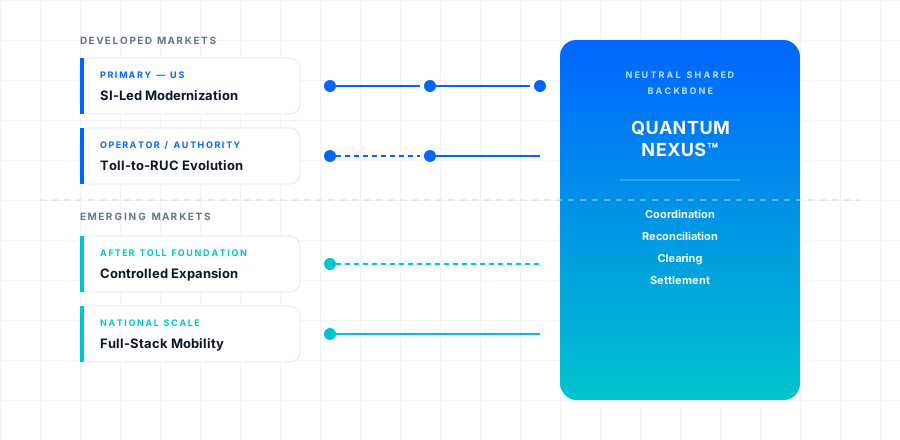
Deployable through operator-led, agency-led, SI-led, or partner-led programs. Five paths. One coordinated back-office system.
Modernize reconciliation, settlement, and financial visibility within existing toll environments.
Deploy within broader program architectures while reducing custom coordination and settlement complexity.
Extend the same system foundation toward evolving charging models without rebuilding core infrastructure.
Add adjacent domains such as transit, parking, EV charging, or fleets through the same backbone where required.
Deploy a unified multi-domain mobility system from day one, using the same coordinated transaction, reconciliation, and settlement architecture.
Deploy through the model that fits the program — while keeping operators and authorities at the center of control.
Multi-domain is secondary. Expansion and Full-Stack paths extend the same backbone into adjacent domains — transit, parking, EV, fleet — where market needs require. In developed markets, tolling and RUC remain the primary commercial focus.
Tolling is the primary deployment model today. The same system supports evolution toward RUC.
Start with tolling. Extend toward RUC through the same system foundation.
Explore how Quantum Mobility can support your tolling or RUC modernization program.
The system works with pilot programs, SI-led projects, and direct operator partnerships — with defined scope, defined duration, and defined boundaries.